Best practice community science engagement
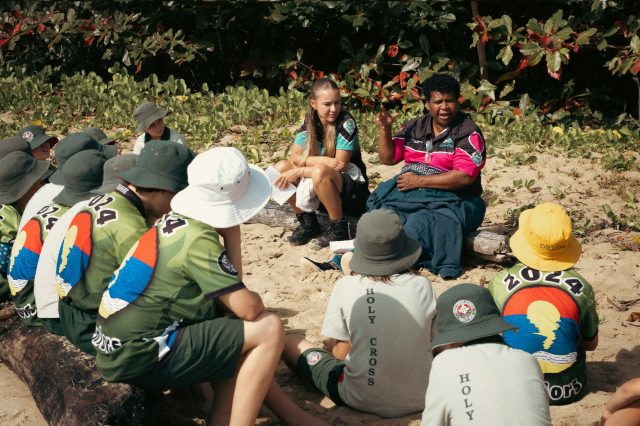
Dawul Wuru Aboriginal Corporation, 2024
There are many reasons for engaging communities in science, for instance:
- to nurture support for, and participation in, science
- to increase awareness and improvements in the scientific process
- to empower citizens through the promotion of science literacy
- to inspire young people to pursue STEM studies and careers.
Griffith University was commissioned to provide the Queensland Chief Scientist with a desktop review for community science engagement programs to guide the design and delivery of engagement initiatives.
The aim of the Best Practice Principles for Community Science Engagement Programs review was to create support for anyone who intends on engaging with communities on science and wants to maximise the impact of learnings.
The report provides a definition of science engagement (as opposed to science communication) as involving two-way interactions between scientific professionals or educators and members of the public to connect, involve, create and empower. It includes sharing, discussing, and co-creating new knowledge and/or scientific understanding.
Due to different backgrounds and past experiences, people do not engage with science equally. The report delves into the need for adopting a science capital approach – building science knowledge and experiences – which is more likely to have sustained impact.
The report provides 13 best practices principles, collated into seven overall recommendations to help guide the design and implementation of community science engagement programs – as explained in our summary fact sheet .
We have also developed a series of fact sheets that provide more detail and case studies around these seven recommendations:
- Recommendation 1: Importance of goal setting and evaluation
- Recommendation 2: Developing strategic alliances
- Recommendation 3: Design for inclusion and accessibility
- Recommendation 4: Hands-on and inquiry-based learning
- Recommendation 5: Engaging key influencers
- Recommendation 6: Connecting educators and engagement professionals
- Recommendation 7: Locally led program design and delivery
The authors also collated some resources to assist educators and science engagement practitioners, and these are shared in the Best Practice Principles for Community Science Engagement Programs - Appendices .
More information can be found in:
- the Best Practice Principles for Community Science Engagement Programs – Final report
- our summary fact sheet and
- the Best Practice Principles for Community Science Engagement Programs - Appendices for additional information and examples.